While public transportation in Japan is among the best in the world, sometimes you want or need a car to get where you’re going. Some sights are only accessible by car and it may be easier for you and your traveling group to have the freedom of movement a rental car allows.
Fortunately, it’s possible even for foreigners to rent and drive cars in Japan, though like any other country there are a variety of requirements would be renters need to follow and options to consider.
This article would be a helpful recourse if you plan on exploring rural parts of Japan, especially in the Tohoku and Hokkaido regions.
Requirements
The minimum driving age in Japan is 18.Anyone who will be driving will need a Japanese driver’s license or an International Driving Permit (IDP) to rent and drive a car.
This requires some advance planning, as International Driving Permits are not issued in Japan. You’ll need to get one issued in your home country, usually for a small fee. With one, you’ll be able to legally drive in Japan for one year.
Keep in mind that Japan only recognizes IDPs issued in compliance with the 1949 Geneva Convention, which is commonly available in most countries. Belgium, France, Germany, Monaco, Switzerland, and Taiwan have separate agreements as they do issue complaint IDPs. If your country doesn’t have an agreement or issue compliant IDPs, you’ll need to get a Japanese driver’s license.
Rental Companies

The largest and most common rental car companies in Japan are Toyota Rent-a-car, Nippon Rent-a-car, OrixRent-a-car, Times Car Rental, Nissan Rent-a-car, and Ekiren. Most offer English services as well as Japanese ones.
More familiar car rental services like Budget and Hertz do offer rental car services, but usually in cooperation with the major local car rental services. Because of this, their rates tend not to be very competitive.
The Rental Process
Renting a car in Japan is similar to renting a car in other countries. The best and easiest option is to book ahead online, usually doable in English. When you go to the designated rental pick-up, you’ll then just have to present your booking details, ID, and driver’s license.
Be sure to ask any questions you may have before leaving and ensure any add-ons you may want are present (car seats, electronic toll collection cards, etc.).
Rates
The usual fees for rental cars are as follows: 5000 yen per 24-hour period for a sub-compact car, 7500 yen for compact cars, 10,000 yen for mid-sized cars, 15,000 yen for full-sized cars, and 20,000 yen for vans. Rates may vary seasonally.
Some companies offer reduced rates for short-term rentals of 6 or 12 hours. These prices usually include unlimited mileage, taxes, and a mandatory minimum insurance fee of 1000 yen per day that covers damage, injury, and liability. They don’t include non-operation fees resulting from damage to the car.
While cars will be expected to be returned with a full gas tank usually, some rental services charge a reasonable rate for re-tanking if you don’t have the time. Extras will be an additional charge. You can pay with either cash or a card.
General Road Rules & Winter Driving

In Japan, cars drive on the left side of the road. Drivers sit on the right. As a general rule, the speed limits in urban areas are 40km per hour, 30km per hour through side streets, and somewhere between 80km and 100km per hour on highways. Always check signs for the posted speed limit.
Japanese expressways require toll payments. It’s possible to avoid these toll roads by taking alternate routes through smaller local streets, but they always take you much longer.
In winter, extra precautions need to be taken. Many parts of Japan see snow in the winter months. In snowy areas, snow tires are provided by default with your rental car.
Watch for ice on roads and use caution when speeding up and slowing down. If you aren’t familiar with driving in winter conditions, it’s best to avoid driving in winter in Japan.
About ETC
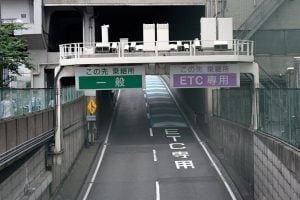
Electronic Toll Collection (ETC) is how tolls are collected on Japan’s expressways and other toll roads. The toll gates can be driven right through if your rental car has an ETC card inserted into the onboard ETC card reader device.
This turns the tolls into a bill you’ll pay later. This is the best way to get around Japan, as it prevents the need for stops to pay at toll booths to wait in line to pay.
There are also discounts for using ETC for tolls depending on a variety of factors, such as using it on a weekend or holiday. You can get everything set up with an ETC card at the rental service.
Learn more about ETC and card and how to use it.
GPS Navigation
GPS navigation is built into many rental cars in Japan. However, it is not always available in English depending on the company or pickup location.
Be sure to check with your rental company to ensure there is English language GPS navigation available in your rental. The easiest way to find your destination on a GPS in Japan is to input its phone number.
Gas Station
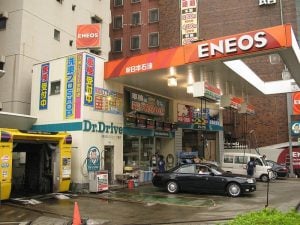
There are both full-service and self-service gas stations in Japan. Full-service stations are more traditional in Japan and slightly more common than more recent self-service stations.
For full-service gas stations, you’ll need some rudimentary Japanese language skills to tell the attendant what kind of gas you want, how much gas you want, and how you will be paying.
All you’ll need to do is park, turn off your engine, and roll down your window to speak with the attendant. The attendant may offer some services to help keep your car interior clean. When done, he or she will ask which direction you want to leave in and will then direct you out to traffic.Self-service stations only have menus in Japanese.
Parking
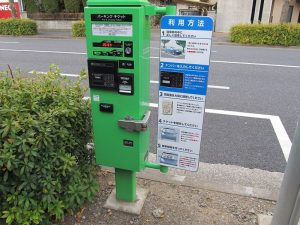
In Japan, the larger the city and the nearer the city center, the more expensive it will be to park. Conversely, parking in small towns and rural areas is often free. Sometimes large attractions like national parks will charge a flat parking fee. Urban hotels often do the same, though less urban ones will usually offer complimentary parking.
There are a few unique parking garages. The elevator parking lots can be found in many places. Drivers are directed to park their car in an elevator, which will then store the car in the tower. When it’s time to hit the road again, the car will be fetched by the elevator.
Small urban parking lots will sometimes have low barriers underneath the cars which raise up to physically block in every individual vehicle. Once the parking fee has been paid either at a central payment machine or at the parking space itself, the barrier will lower and you can leave.
Read this guide to find out exactly where and how to use a parking lot in Japan.
Returning the Car
Returning in a rental car is much the same as you find in other countries. In most cases, you can return the rental car to a different location for the same rental company. Be sure to fill up the gas tank before returning the car.
Some rental companies and locations are ready to refill the gas for you but not most. Having some Japanese language skills will be helpful for returning the rental car, but isn’t necessary.
Do I actually need a rental car in Japan?
Japan provides many excellent transportation options for those who don’t want to deal with the hassle of renting a car. However, the freedom of movement a car offers can be very appealing and allow you to experience the country in a way just not possible using rail and bus options.
In most urban areas, a rental car is going to be an expensive pain more than anything else and is probably not the best option for most travelers. However, some destinations provide very limited public transit options, like Okinawa or Hokkaido, and a rental is advisable to have full freedom of travel. Planning and research are key to knowing if getting a rental car is right for your trip to Japan.