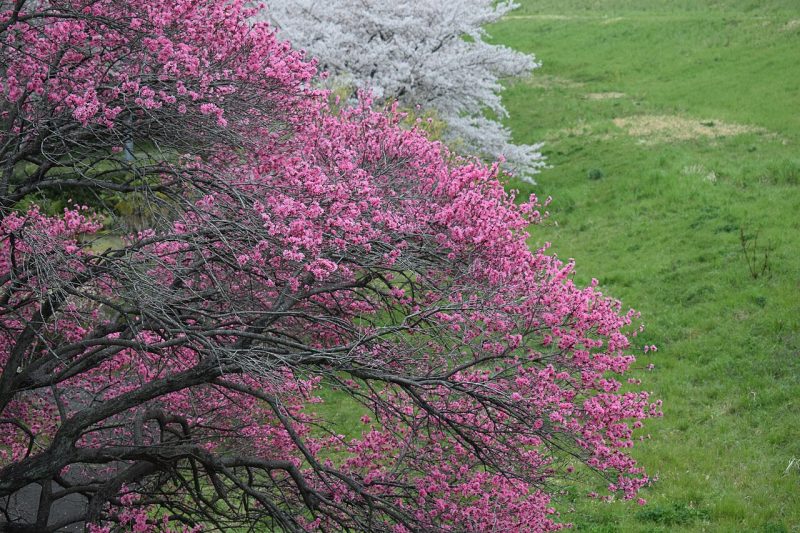
The beauty of peach blossoms in Japan fascinates many travelers across the world, especially for those looking to see spring flowers in Japan. There are many amazing places to discover in spring in Japan including the ones mostly renowned for flower viewing.
Peach trees originated to Japan from China around 6000 years ago during the Yayoi period. You can enjoy peach blossoms for about 2-3 weeks before cherry blossoms appear, typically they bloom in early March every year.
The peach blossoms play a significant role in Japan’s cultural traditions, especially during the Girl’s Day celebration (Hina Matsuri) on March 3. Yamanashi Prefecture’s Fuefuki city is one of Japan’s most impressive places to admire these pink blossoms.
How to identify a Japanese peach blossom

You need to look carefully at Japanese peach blossoms to separate them from other spring flowers. These beautiful blooms have unique features that will boost your appreciation during your travels.
Petal shape and stem length
Japanese peach blossoms have petals with pointed tips that taper to sharp ends, creating a teardrop-like appearance. The petals take on an oval or teardrop shape with a fine point at the end. This feature makes them easy to spot among spring blooms throughout Japan.
On top of that, peach blossoms grow on remarkably short stems, much shorter than cherry blossoms. The flowers seem to attach directly to the branch because of these tiny stems. A fully opened peach blossom reaches about one inch (2.5 cm) wide. The flower shows off five petals, each measuring about 1/2 inches long by 3/8 inch wide (1.3 cm × 0.95 cm). This compact, close-to-branch appearance creates a completely different visual effect from other spring flowers.
Color variations and flower clusters
Peach blossoms display shades ranging from soft white to vivid pink, and even rich, deep red. Cherry and plum blossoms might appear in white or light pink, but peach blossoms almost always display various pink shades. This consistent color helps separate them from other spring flowers.
The blossoms have a special growth pattern where two flowers bloom from the same point on the branch. This paired flowering creates an incredibly lush, abundant display that’s quite different from other spring blossoms. When you spot this two-flowers-per-spot pattern, you’ve found your peach tree! This arrangement gives peach trees a much more dramatic, flashy appearance compared to the more subtle plum blossoms.
Differences from Sakura and Ume
Cherry blossoms (sakura) have a small split or notch at each petal’s end, while peach blossoms feature smooth, pointed tips. Sakura blooms grow on longer stems and cluster together from one point, which creates their dramatic effect.
Plum blossoms (ume) stand out with their evenly rounded petals, unlike the teardrop shape of peach blossoms. Ume flowers bloom right from the branch without stems, but peach blossoms grow on short stems with pairs of flowers from roughly the same spot.
Bloom timing helps tell these flowers apart. Plum blossoms show up first (February-March), then peach (March-April), followed by cherry blossoms. The colors tell a story too – only plum blossoms can achieve an almost crimson shade of purple, making dark purple flowers definitely ume rather than peach or cherry.
Cultural importance of peach blossoms
In Japan, peach blossoms are more than just beautiful flowers as they carry the most important symbolic meanings that have shaped Japanese traditions, art, and spiritual beliefs for centuries.
Role in Girl’s Day (Hinamatsuri)
Japanese culture celebrates one of its most cherished festivals—Hinamatsuri or Girls’ Day—every year on March 3rd. The festival’s roots go back over 500 years ago when it was known as Momo no Sekku (Peach Festival). Peach trees bloom naturally in early March, which makes these flowers the perfect symbol for this celebration.
Families celebrate Hinamatsuri by displaying elaborate arrangements of traditional hina dolls that represent the Emperor, Empress, and their court, with peach blossoms as their backdrop. These blossoms do more than just decorate—people believe they protect young girls’ health by warding off evil spirits. The homes come alive with peach blossoms that create a protective environment while celebrating feminine grace.
Use in traditional art and poetry
Japanese artists and poets have long been fascinated by peach blossoms. These flowers are widely featured in traditional paintings, poetry, and songs, symbolizing renewal and the arrival of spring.
Peach blossoms embody the concept of mono no aware in Japanese literature—the poignant awareness that nothing lasts forever. This philosophical idea sees beauty in things that don’t last!
Symbol of femininity and good fortune
Japanese cultural traditions view peach blossoms as symbols of:
- Feminine beauty and grace
- Longevity and vitality
- Protection from evil
- Happy marriage and prosperity
Hanakotoba (the Japanese language of flowers) sees peach blossoms as messengers of charm, calmness, and happy marriage prospects.
Top places to enjoy peach blossom season in Japan
Japan has some of the most beautiful spots to see peach blossoms at their peak. Let me show you the best places to see these pink wonders, from quiet mountain villages to vast orchards.
Hanamomo-no-sato
Peach Blossom, Achi Village, Nagano
Achi Village comes alive with about 10,000 peach trees blooming from mid-April to early May. Red, white, and pink blossoms create a spectacular view along the village slopes for several kilometers. The yearly Hanamomo Festival shows off local farm products and lights up the blossoms from 6 pm to 11 pm. Guests can take the Hanamomo Bus from Hirugami Onsen to reach this beautiful spot.
Kaminaka
Weeping Peach Blossoms, Aichi
Toyota City’s Kaminaka features about 3,000 weeping peach trees that create stunning curtain-like effects along a one-kilometer walking path. Local residents started this beautiful display in the mid-1960s by planting 30 trees. They kept adding more trees each year until they created a mixture of white, red, and pink blooms on the mountainside. The best time to visit is early to mid-April, when you can enjoy the festival with food stalls and local treats.
Kamikuki Peach Blossoms, Kochi
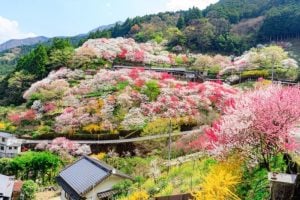
Kamikuki in Niyodo town showcases what dedication can create. From late March to early April, entire mountainsides come alive with red, white, and pink peach blossoms — all thanks to devoted local residents who spent 15 years planting and nurturing these frost-hardy trees. You’ll love wandering the small paths that wind past farmers’ fields and colorful trees, often spotting koi nobori carp streamers dancing in the breeze for Children’s Day.
Koori Town’s Peach Blossoms, Fukushima
Koori Town proves that the best peach destinations aren’t always the most famous ones. As Japan’s second-largest peach producer, this town is serious about its peaches — they even present their prized Akatsuki cultivar to the Imperial Family annually since 1994. When spring arrives, 120 hectares of Togenkyou fields transform into a pink wonderland. The famous “Peach Line” follows the Abaukuna river, where thousands of flowering trees create what locals call a “pink sheet of blossoms”.
Fuefuki Spring Festival, Yamanashi
“Peach City” Fuefuki has more than 300,000 peach trees that bloom in early April. The Spring Carnival runs through late March and early April with lots of fun events. Mt. Fuji stands tall above a sea of pink blossoms, creating perfect photo spots. Yamanashi makes three times more peaches than any other prefectures, making it a top peach blossom viewing spot in Japan.
Koga Kubo Park, Ibaraki
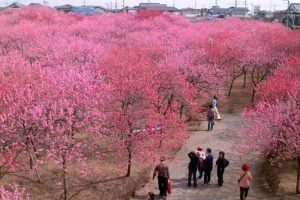
Koga Kubo Park offers variety that peach blossom enthusiasts dream about. With 1,500 peach trees representing six different varieties blooming from March to April, there’s always something new to discover. The renowned Koga City Peach Blossom Festival has been drawing visitors since 1977, attracting over 200,000 people each year.
Shimpu Togenkyo, Yamanashi
The name says it all — “Togenkyo” means “utopia” or “otherworldly,” and Shimpu Togenkyo in Nirasaki City lives up to every bit of that promise. Spanning approximately 60 hectares of peach orchards, this isn’t just for show — these are working fruit trees that happen to create an incredible spectacle when they bloom in mid-to-late April. The contrast is absolutely stunning: delicate pink blossoms set against the dramatic backdrop of snow-capped Minami-Alps mountains, Mt. Fuji, and the majestic Yatsugatake volcanoes.
Planning your peach blossom trip
A great trip to see Japan’s magnificent peach blossoms needs perfect timing and the right local activities. The right preparation helps you catch these fleeting flowers at their most beautiful.
When is peach blossom season in Japan?
The peach blossom season changes in different parts of Japan. These delicate flowers usually appear from late March to mid-April. The exact dates shift based on where you are and the weather. Some warmer spots might see blossoms as early as late February, about 2-3 weeks before cherry trees bloom.
Here are the best times to see blossoms at popular spots:
Achi Village (Nagano): Mid-April to early May
Kaminaka (Toyota, Aichi): Early to mid-April
Kamikuki (Kochi Prefecture): Late March to early April
Fuefuki City (Yamanashi): Late March to early April
Koga Park (Ibaraki): March to April
Most festivals happen right when the blossoms peak. To cite an instance, Yamanashi’s Hanamomo-en welcomes visitors from March 10 to April 10.
Combining peach blossom viewing with local experiences
The beauty of these flowers is just the start of what you can enjoy at peach blossom spots. Koga’s Peach Blossom Festival features a special outdoor tea ceremony right under the flowering trees. This tradition gives you a real taste of Japanese culture.
The local food scene adds another layer to your visit. Koga serves special peach blossom-inspired sweets with local Sashima tea. Yamanashi’s farms offer chrysanthemum tea with treats, and you can buy peach jam or preserved slices to take home.
A car gives you the most freedom to reach these blossom spots. Achi Village charges about ¥500 for parking, but public transport works too. The trip from Tokyo to Achi-mura takes four and a half hours by highway bus, local bus, and train.