Walking through Tokyo’s most vibrant neighborhoods after sunset feels like stepping into a completely different city. That’s what I believe! When those neon signs start glowing and the streets come alive with energy, you realize Tokyo’s true personality only emerges once darkness falls.
I still remember that first evening in Shibuya—the way the crossing pulsed with thousands of people while giant screens bathed everything in electric light. That moment hooked me on Tokyo nights, and honestly, I’ve been chasing that feeling ever since.
Whether you’re after quiet moments of cultural discovery or high-energy adventures that push boundaries, these nighttime experiences capture what makes Tokyo truly unforgettable. Let’s explore some of the most famous places you can explore in Tokyo at night.
1. Sensoji Temple, Asakusa
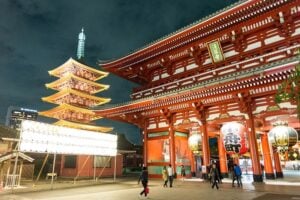
I think Sensoji Temple is one of the best places to visit in Tokyo at night. Built in 628, this famous Japanese Buddhist temple becomes something magical once darkness falls and the crowds disappear. You’ll find yourself sharing the space with maybe 70-80% fewer people than during peak hours—a rare gift in Tokyo.
The temple illumination runs from sunset until 23:00 each night, bathing the traditional buildings in warm, dramatic light. That iconic Kaminarimon Gate and Five-story Pagoda take on an entirely different presence under spotlights. The photography opportunities here are extraordinary after dark. Position yourself on the main hall steps for dramatic upward angles.
Sensoji’s position along the Sumida River creates wonderful evening walks once the temple visits wind down. The riverside path grows peaceful after sunset, offering views of Tokyo Skytree’s illumination shows.
2. Shibuya Sky
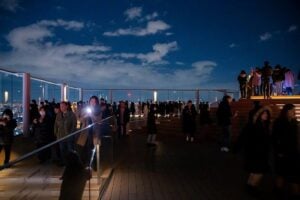
Standing 229 meters above Shibuya Scramble Square, Shibuya Sky delivers what I consider one of Tokyo’s most thrilling viewing experiences. What makes this observation deck special isn’t just the height—it’s the completely open-air design on the 47th floor. No glass barriers block your view, so you feel the wind on your face and breathe the night air while Tokyo spreads endlessly below.
The experience starts with an elevator ride that incorporates 3D sound, images, and light effects. Once you reach the top, three zones create different perspectives. The SKY GATE escalator takes you upward with dramatic flair, the indoor SKY GALLERY showcases digital art displays, and the SKY STAGE provides that unobstructed 360-degree view where Tokyo reveals itself in every direction.
From this observatory, you can watch the famous Shibuya Scramble Crossing pulse directly below, see Tokyo Skytree piercing the northeastern sky, and on clear nights, spot Mt. Fuji’s distinctive silhouette to the southwest. The Imperial Palace appears as a green island surrounded by urban development, while Tokyo Bay and Yoyogi Park stretch across different angles.
3. Sumida River Night Cruises
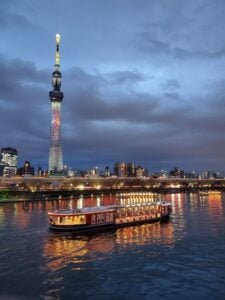
Drifting along Tokyo’s historic waterway after sunset reveals the city from an entirely different angle. Yakatabune—traditional Japanese party boats—carry you through this floating world where paper lanterns cast warm glows across wooden decks and the gentle lap of water mingles with distant city sounds. These vessels capture something of old Tokyo’s spirit, creating that nostalgic atmosphere you can only experience on the river at night.
The Hotaluna catches attention immediately among cruise options. Designed by renowned manga artist Leiji Matsumoto, this spacecraft-like vessel glides through Tokyo’s waterways with a viewing deck that creates firefly-like illumination across the Sumida River.
Dinner cruises offer the most complete evening experience. Starting from Azumabashi in Asakusa’s heart, these traditional boats carry you down the Sumida River toward Tokyo Bay while serving authentic Japanese cuisine. You’ll pass under Rainbow Bridge and see Odaiba’s lights reflecting off the water.
For pier location, timetable and fare, please visit this page: https://www.suijobus.co.jp/en/
4. Shibuya Crossing
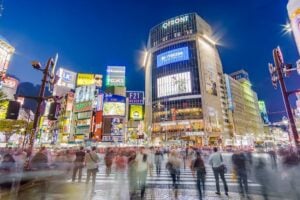
Standing at the heart of what might be the world’s busiest pedestrian intersection feels like witnessing organized chaos at its finest. Between 1,000 and 2,500 people surge across Shibuya Crossing every two minutes during peak periods, creating a mesmerizing dance of movement that becomes truly spectacular once those neon signs start blazing.
The crossing reveals its true character when dusk arrives. Suddenly, every screen and sign ignites in electric color, casting that unmistakable glow that rivals Times Square.
Photography here becomes an art form after dark. Early evening delivers the brightest neon against the busiest streets, where countless compositions present themselves as that colorful glow bathes the endless stream of crossers. The famous Hachiko Statue sits just outside the station’s main exit, commemorating the loyal Akita who waited faithfully for his owner even after death.
5. Tokyo Skytree
.jpg)
Standing 634 meters above Tokyo, Skytree transforms into a glowing structure each evening, its illumination shows visible from every corner of the city. Starting at 19:00, the tower cycles through mesmerizing light displays that change every two and a half minutes!
The Tembo Deck on Floor 350 opens up Tokyo’s white nightscape in all directions. Japan’s love affair with fluorescent lighting means the city glitters like scattered diamonds rather than glowing orange like other world capitals. From this height, you’re practically touching the edge of space—the horizon curves away beneath you while the city sprawls endlessly in every direction.
6. Golden Gai
.jpg)
Golden Gai is located in Shinjuku, one of the vibrant neighborhoods in Tokyo, where you can find out more than two hundreds of tiny bars. These bars are packed by both locals and tourists alike.
It’s hard to beat Tokyo’s bars. I have been to Shinjuku many times over the years and what I loved most about it wasn’t just the iconic Shinjuku Gyoen National Garden, but also a trip to Golden Gai. You must discover Golden Gai, a true hidden side of Tokyo.
As the sun goes down, I watch the narrow alleys come alive with glowing neon signs and soft lantern light, creating a cozy, almost magical atmosphere. You can chat with locals; meet fellow travelers, and stepping into tiny bars that each had their own story. For me, it’s one of the best ways to experience Tokyo nightlife in a more authentic and relaxed way, where every stop feels like a new discovery.
7. Kabukicho
.jpg)
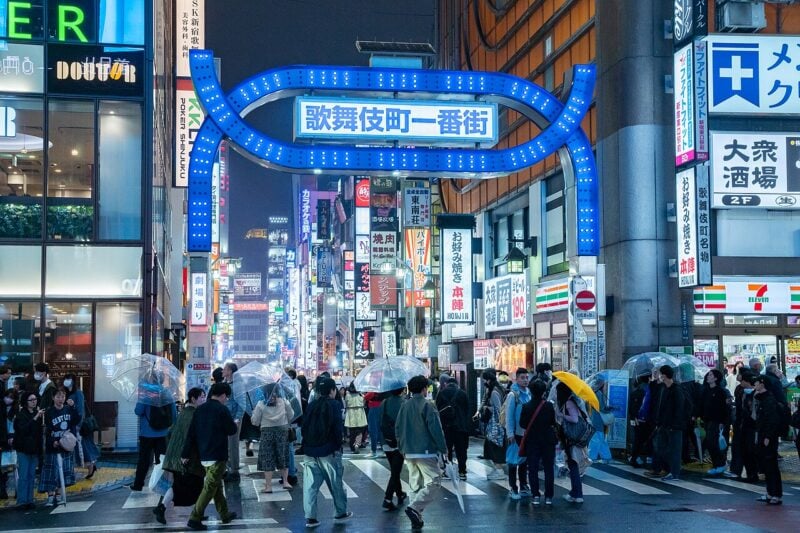
Shinjuku’s nightlife is truly mind-boggling. You can walk through Kabukicho after dark and you’ll understand why—over 3,000 bars, nightclubs, love hotels, massage parlors, and hostess clubs somehow fit into just 36 hectares. The transformation from its relatively quiet daytime appearance feels almost magical, as neon lights flicker to life and the streets fill with an energy that’s uniquely Tokyo.
Sticking close to the Godzilla Head on the Toho Building gives first-time visitors the safest introduction to the district. Central Road and its surrounding area create what locals call the “blue zone”—well-lit, busy with tourists, and generally welcoming. Once you venture north toward Route 302, you enter the “red zone” where things get more intense, especially after midnight when aggressive touts and potential scams become more common. I always recommend you starting in the safer areas and getting a feel for the place before exploring further.
Your budget shapes everything here. Game centers keep things affordable at ¥100-200 per play, while karaoke can range from ¥1,000-4,000 depending on your package and timing.
Let me introduced to you something interesting there. It’s called Omoide no Nukemichi, which offers a completely different vibe from the main strips. This narrow alleyway houses tiny izakayas serving cold beers and yakitori in an atmosphere that feels authentically local rather than tourist-focused. It’s my go-to recommendation for anyone wanting to experience Kabukicho’s night vibe.
The new Kabukicho Tower, which opened in 2023, brings family-friendly entertainment to the district with giant crane games, escape rooms, a food hall, and live music venue.
Early evening to midnight captures Kabukicho at its most manageable—all the neon atmosphere with fewer crowds and less aggressive touts. The district never truly sleeps, but those hours give you the best balance of excitement and comfort.
8. Roppongi
.jpg)
Roppongi plays by completely different rules than anywhere else you’ll experience in Tokyo’s nightlife scene. When Roppongi Hills opened in 2003 as a luxury complex, it reshaped the entire neighborhood’s character, transforming what was once a gritty expat bar scene into Tokyo’s most international nightlife destination.
As night falls and Tokyo Tower begins illuminating the streets with that iconic red glow, the transformation into one of Tokyo’s most vibrant party neighborhoods becomes complete. The crowd shifts dramatically too—expats mixing with locals, influencers rubbing shoulders with business types, everyone dressed to impress rather than the casual streetwear you’ll see in other districts.
Nightclubs here range from cozy 100-person venues to sprawling 1,000-person dance floors, with music spanning hip hop, R&B, EDM, and techno. This is an ideal night attractions in Tokyo for anyone wanting to experience the city’s most cosmopolitan side.
9. Akihabara

Most visitors to Tokyo love visiting Akihabara! Have you ever been there? This electric town takes on a completely different personality once the sun goes down! Walking through Akihabara at night feels like stepping into a neon-soaked video game world where towering advertisements glow against the darkness and arcade sounds spill onto every street corner. Honestly, nowhere else captures this particular slice of Japanese pop culture quite like Akihabara after dark.
There are many Maid cafes to visit in the area. If you have a plan on visiting maid cafes in Tokyo, come to Akihabara. You will be surprised! The experience goes far beyond just food—these cafes offer entertainment, conversation, and performances that provide authentic glimpses into otaku culture.
Game centers come alive with a special energy after sunset. TAITO Station buzzes with the latest arcade games, music games, and competitive fighting tournaments that draw serious gamers from around the world.
For first-time visitors, I’d recommend starting with a maid cafe experience, then moving on to a gaming cafe, and finishing the night with arcade entertainment. This progression captures the essence of Akihabara’s evening attractions in one memorable night, offering experiences you simply won’t find anywhere else in Tokyo—or the world, for that matter!
10. Nakano Broadway

Just west of Shinjuku, you’ll discover a shopping complex that feels like Tokyo’s best-kept secret. Nakano Broadway opened back in 1966 and has quietly evolved into something special—a treasure trove for anime, manga, figures, idol goods, and retro games. Think of it as Akihabara’s more approachable cousin, where prices stay reasonable and you can actually cover the entire building in one evening without feeling overwhelmed.
The building reveals different worlds as you move between floors. Head down to the basement and you’re suddenly in a proper local food market where neighborhood residents shop for fresh produce, meat, and seafood. It’s a glimpse into everyday Tokyo life that most tourists never see. The ground floor keeps things familiar with clothing, shoes, and second-hand treasures scattered throughout—still it feels like a regular community mall. But climb those stairs to the upper levels, and that’s where the magic happens. Narrow corridors pack in Mandarake branches and hobby shops that could swallow hours of your evening.
Those Mandarake stores spread across the second and third floors like a sprawling treasure hunt, with over a dozen specialized shops each focusing on their own obsessions. One might specialize in classic manga, another in character figures, while the next overflows with vintage toys, model kits, or idol merchandise.
Nakano Broadway keeps doors open from 10:00 to 20:00, just a five-minute walk north from Nakano Station. No parking means you’ll rely on public transport, but that’s actually perfect. Evening hours transform the entire area into a neighborhood hangout where you can spend hours treasure hunting, and then slip into one of those backstreet izakayas for authentic Tokyo nightlife that feels wonderfully removed from the tourist crowds.